
Photographing whitetail deer during the rut is not about finding a better spot. The deer changes behavior every few days — and the sit that worked last week can sit empty this week for reasons that have nothing to do with you.
The short version: in seeking, bucks cruise in daylight and you photograph movement. In chasing, everything gets fast, and position beats patience. At peak breeding, patterns vanish. Afterward, the woods go back to food, and so do the deer.
A hunter needs one deer, once. You need a deer behaving naturally, in light worth shooting, long enough to compose. That starts with knowing which phase you are in.
Seeking: bucks are moving in daylight
In the Northeast, seeking runs roughly through the first week of November — around November 7 in a typical year, though timing shifts with latitude and local conditions. Does are not yet receptive, but bucks are checking: cruising feeding areas, working scrapes, traveling routes they ignored in October.
This is the most forgiving phase of the rut. Movement happens in daylight, often in the first and last hours, and it follows lines you can read — edges, funnels, trails between bedding and food. A sit on a travel route has a real chance here.
Camera-wise, seeking is a readiness game. Deer appear at a walk or a trot, usually at middle distance. You need the camera already set up — tracking focus, shutter fast enough for a walking deer — and your support pointed at the likely opening, not resting in your lap.
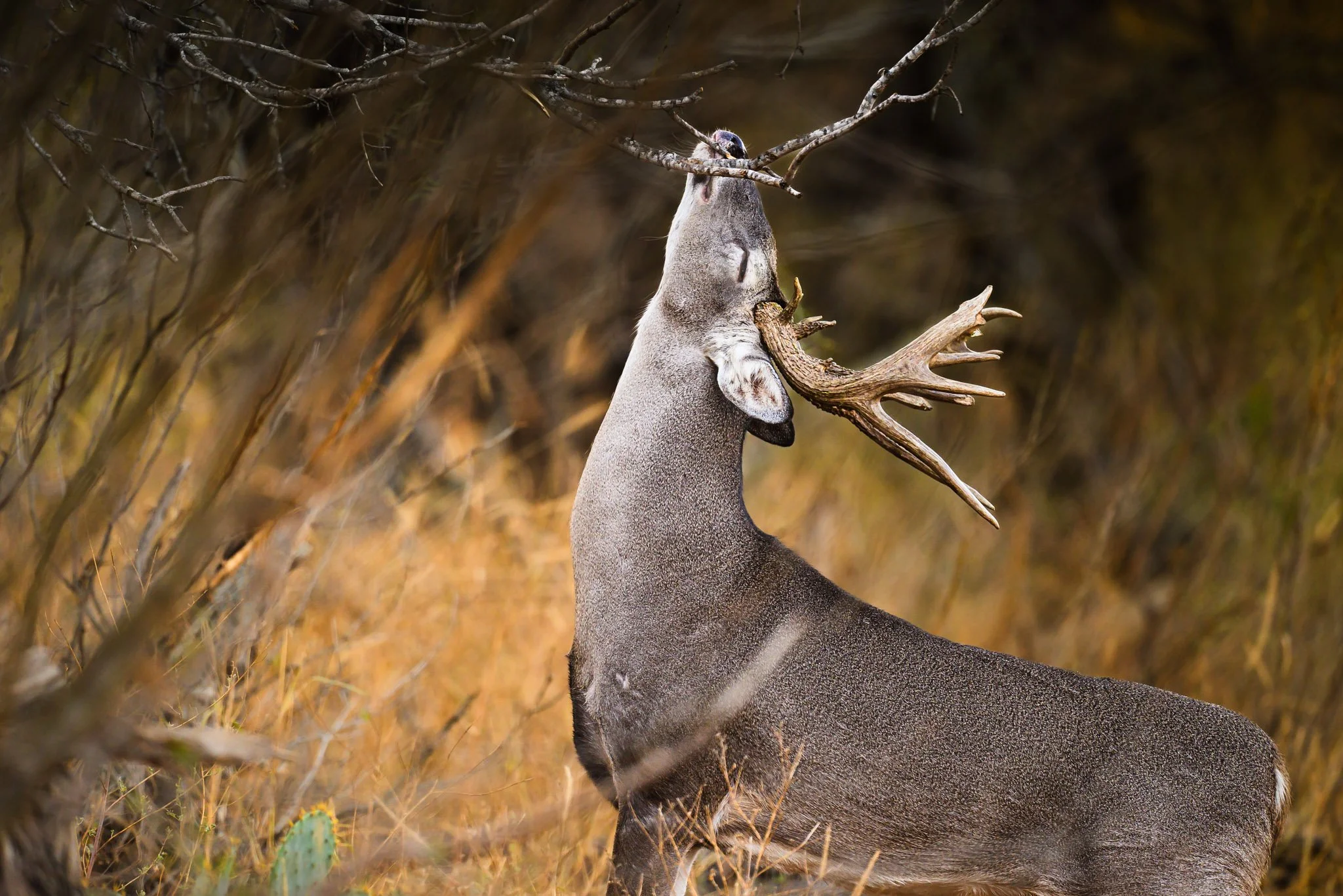
A whitetail buck rubbing on a low-hanging branch after working a scrape. Photograph by Dominick Gatto, TX 2022
Chasing: fast, close, and over in seconds
From roughly November 8 in the Northeast, seeking tips into chasing: a doe close to estrus gets followed, then pursued, sometimes by several bucks. This is the phase people picture when they say "the rut" — and the hardest to photograph well.
Chases do not follow your plan. That is why doe bedding areas and the funnels leading out of them outproduce food plots now: the action happens where the does spend their days.
In seeking, you wait for a deer to come to your frame. In chasing, you pick where a chase is likely to cross and accept that most crossings will be too far, too fast, or behind brush. When one does come through, it will be at speed — so raise your shutter speed past what the light seems to ask for, accept the higher ISO, and decide settings in advance. Choosing settings while a buck chases past at thirty yards means you are already late.
And stay put. Noise means deer already alert and moving; relocating toward it usually ends the show for everyone, including you.
Lockdown: when the patterns vanish
At peak breeding, a buck pairs with a receptive doe and stays with her — often in thick cover, often for a day or more. Multiply that across the herd and the woods feel suddenly empty.
For a hunter, a locked-down buck is nearly impossible to pattern. It should frustrate you less — you are not owed an encounter. Lockdown is a patience phase: sits near thick bedding cover, waiting on the short movements a paired doe makes to feed or water. The photographs are rarely dramatic. They tend to be quiet and close — a deer resting in cover, as it actually lives.
The absence of deer is information, not failure. The phase will turn.
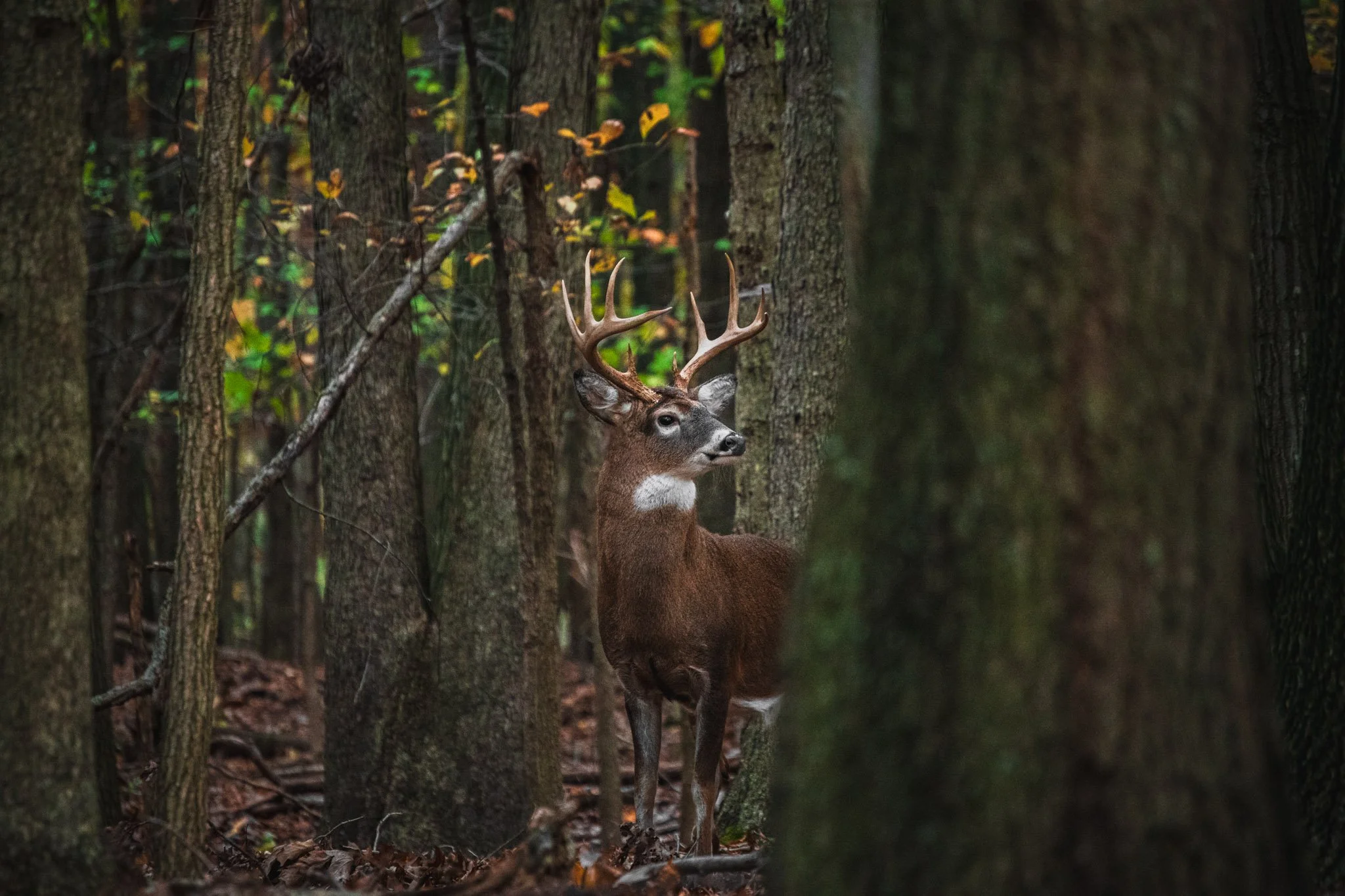
A mature whitetail buck peeking through the trees during the post-rut. Photograph by Dominick Gatto, NY 2019
Post-rut: back to food, back to patterns
After peak breeding, bucks are depleted and the woods reorganize around calories. Food matters again — remaining acorns, cut fields, whatever stored energy is left. Movement gets more predictable, more tied to dawn and dusk, and more photographable in the open.
There is also a smaller, later pulse: unbred does can come into estrus roughly a month later — not a second rut, but a few days of renewed buck movement in December.
Post-rut deer are also warier — pressured for weeks, by hunters and by each other. Your margin for movement and noise is thinner than in October: earlier in, quieter, still longer.
The ethics of photographing the rut
Rut deer are stressed deer. Bucks are burning reserves they need for winter; does are being pursued whether they cooperate or not. The rule: photograph the behavior, don't add to the pressure producing it.
No pushing a buck off a doe for a cleaner angle. No repeated approaches to the same deer in a day because the light improved. No calls, scents, or staging where they are not permitted. If a deer changes what it was doing because of you, you were too close.
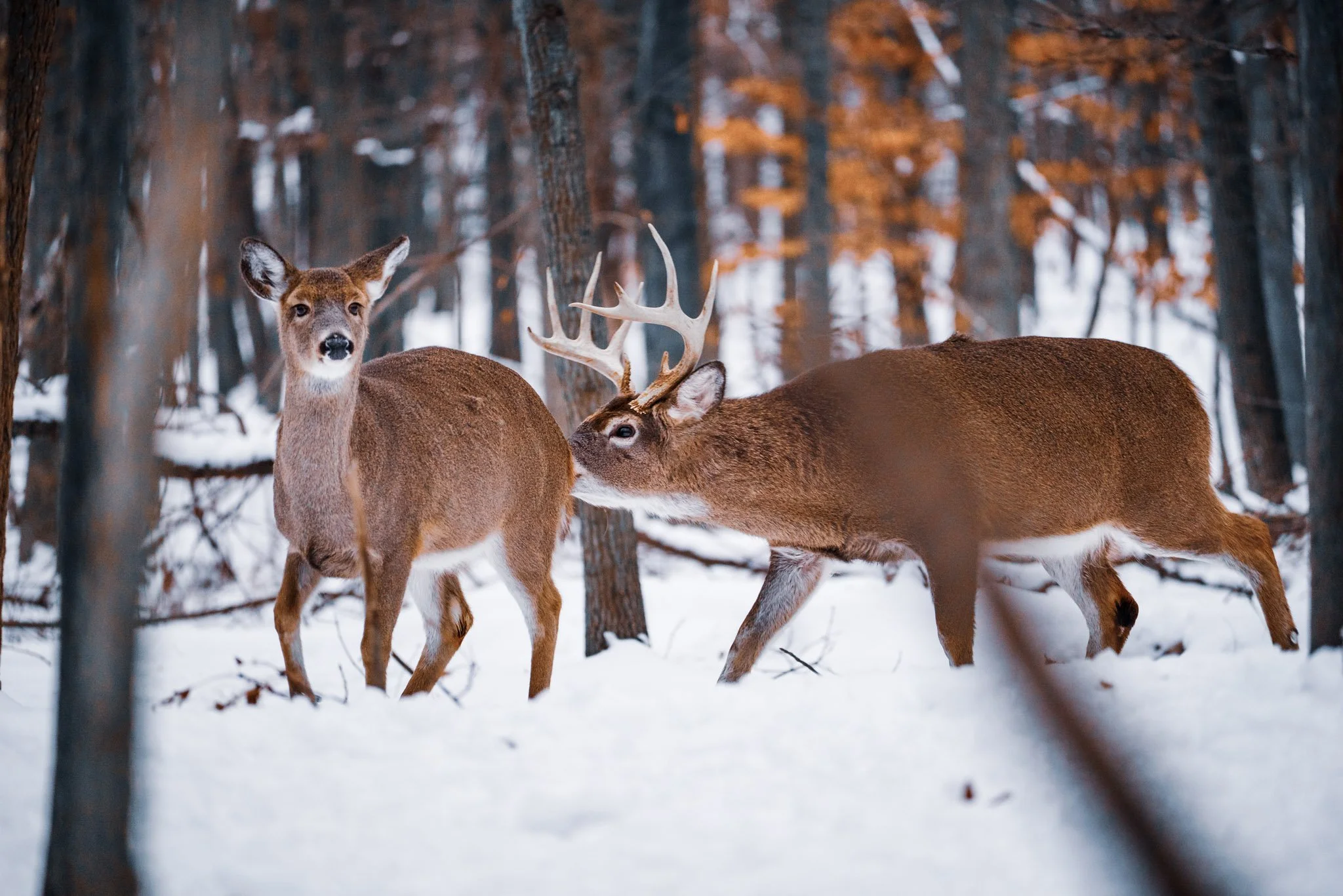
A mature whitetail buck chases a doe in the snow-covered timber. Photograph by Dominick Gatto, NY 2020
The takeaway
The rut is not one event. It is a sequence: seeking rewards a travel route, chasing rewards position near doe bedding and the discipline to stay put, lockdown rewards patience in thick cover, post-rut rewards a return to food and fundamentals.
None of it rewards rushing. Read the wind, read the light, be in position early, and stay still long enough for the forest to forget you are there. The rut raises the stakes, because its moments do not repeat.
FAQ
When is the best week to photograph the whitetail rut?
In most of the Northeast, chasing — roughly the second week of November — produces the most daylight buck movement. The seeking week before it is more predictable, and often better for composed shots.
Where should I sit to photograph rutting deer?
During chasing, sit near doe bedding areas and the funnels leading out of them, not over food. Bucks go where the does already are.
What shutter speed do I need for a chasing buck?
Faster than feels comfortable — a running deer blurs at settings that freeze a walking one. Raise ISO to buy shutter speed; sharp with noise beats clean and blurred.
Why did deer movement stop in mid-November?
Usually lockdown: bucks paired with does in thick cover. Movement has not stopped, it has shrunk — and it reopens as pairs break up.
Is it ethical to photograph deer during the rut?
Yes, if you add no pressure: work where deer behave as if you are not there, never push a deer for a shot, and follow local rules on calls and attractants.
Go deeper
This post is one phase of a larger system — sign, wind, light, close encounters without pressure. That full system is The Hunter's Guide to Wildlife Photography.

The Wild Doesn’t Wait for You
The Hunter’s Guide to Wildlife Photography is not a technical manual. You won’t find pages of charts, gear lists, or step-by-step settings for every scenario. Instead, you’ll learn the quiet skills that hunters have relied on for generations - patience, awareness, and the ability to disappear into the environment - and how to turn those instincts into images that hold the wild within them.
Out here, there are no second chances. The moments worth capturing appear without warning, and they vanish just as quickly. The best images aren’t the product of perfect camera settings - they’re the result of reading the wind, knowing the light, and moving as if you belong in the landscape.
Every lesson comes from the field: long sits in the cold, the electric stillness before a deer steps into view, and the discipline to wait for a single moment that tells the whole story.
If you’ve ever wondered why some photographers seem to be in the right place at the right time, it isn’t luck. It’s fieldcraft.
And you’re about to learn it.
Included in this digital purchase are PDF and EPUB files which have been formatted for use on popular devices and apps including Kindle, Apple Books, Google Play Books, Kobo, Nook, and most computers, tablets, and smartphones.
